What palliative care and hospice care mean
WHO defines palliative care as an approach that improves the quality of life of patients, adults and children, and their families who face problems associated with a life-threatening illness. It prevents and relieves suffering through early identification, assessment and treatment of pain and other problems, whether physical, psychosocial or spiritual.
- It is not only for cancer. WHO says most adults who need palliative care have cardiovascular disease (38.5%), cancer (34%), chronic respiratory disease (10.3%), AIDS (5.7%) or diabetes (4.6%). It also names kidney failure, chronic liver disease, dementia and Parkinson’s disease, among others.
- It is not only for the last weeks. WHO lists the idea that palliative care is only for cancer patients or for the last weeks of life as a misconception, and says early palliative care reduces unnecessary hospital admissions.
- End of life care is the part of palliative care given when someone is approaching the end of life. The NHS describes this as usually when a person is likely to die within the next 12 months, although that is not always possible to predict.
The Malaysian Hospice and Palliative Care Council (MHPCC) explains that in some countries “hospice” is used to tell home or community services apart from hospital services, but that the principles of care are the same. In Malaysia, most community teams call themselves a hospice or a palliative care society. A Malay version of this guide is at hospis dan penjagaan paliatif.
Palliative care services in Malaysia
| Provider | What it offers | Source |
|---|---|---|
| KKM hospitals | In 2019, 7 KKM hospitals had palliative medicine specialists and 4 of them had inpatient palliative units. In October 2025 the Health Minister said there were 34 palliative care doctors in KKM hospitals, with a target of 50 within two years. | KKM policy 2019–2030; Malay Mail, 11 October 2025 |
| KKM PPD Paliatif (home care) | Home care for patients with an illness that will not be cured, such as end-stage cancer, through a referral from a hospital or health clinic. MyGOV says the service is not yet available in WP Kuala Lumpur, Putrajaya and Labuan. MHPCC says it is still developing and available at selected sites. | MyGOV, updated 13 March 2026; MHPCC |
| Hospices (non-profit organisations) | In 2019 there were 30 organisations covering every state except Perlis, 28 of them offering home care, provided free of charge. The policy notes that services are most active in large towns such as Kuala Lumpur, Klang, Ipoh and Penang, and that many smaller towns and rural areas have none. | KKM policy 2019–2030 |
KKM’s statement for World Hospice and Palliative Care Day (11 October 2025) said fewer than 10% of patients who needed palliative care received it in 2019, rising to 14.5% in 2025. The Health Minister estimated that about 180,000 Malaysians would need palliative care that year.
Hospices in Malaysia and the areas they cover
This table lists only hospices whose terms we could check on their own websites. It is not a complete list: the MHPCC member directory lists more hospices, including in Johor, Kedah, Melaka, Kelantan, Terengganu, Pahang, Negeri Sembilan and Sabah, and others in Kuching and Sibu.
| Hospice | Area | Cost | Notes |
|---|---|---|---|
| Hospis Malaysia | Parts of the Klang Valley (ask whether your address is covered); one centre, in Cheras | Free | Needs a referral from the treating doctor. Does not provide nursing help in the home; the team teaches the family carer. Outpatient consultation in Cheras for people outside its home-visit area. |
| Hospice Klang | Klang and surrounding communities | Free | A family member or carer can start the referral (the form asks for the referring doctor’s details). Lends hospital beds, oxygen machines and wheelchairs free of charge. |
| Kasih Hospice Foundation | North Kuala Lumpur and nearby Selangor on its coverage map (Kepong, Jinjang, Segambut, Selayang/Batu Caves, Sungai Buloh, Rawang, Bandar Sri Damansara), with some exclusions | Free | For stage 4 cancer and end-stage kidney failure. Lends hospital beds, wheelchairs and oxygen concentrators according to need. |
| Penang Hospice Society | Penang island and mainland | Free | Accepts referrals from health professionals, hospitals, families, friends or the patient. Equipment loans are free, subject to availability and eligibility, with a refundable deposit. |
| Perak Palliative Care Society | Ipoh | Not stated; ask | For patients with advanced cancer, preferably with a doctor’s referral letter, and a carer must be at home. Hospital beds and ripple mattresses are lent subject to stock, with a refundable deposit. |
| National Cancer Society Malaysia, Sarawak Branch | Within 20 km of its Kuching office | Free home care; no fee for equipment loans at present | For terminally ill cancer patients. Lends hospital beds, ripple mattresses and other equipment; it must be returned in good working condition. |
| Palliative Care Association of Miri | Miri | Not stated; ask | For registered cancer patients living in Miri, with a doctor’s referral letter. Hospital bed loan with an RM100 refundable deposit (a motorised ripple mattress is listed at RM100); the deposit can be waived if the family has financial difficulty. The family collects the equipment with its own transport. Subject to availability. |
Terms change. Contact the hospice for its current area, the conditions it accepts and any waiting list.
How to get palliative care
- Ask the treating doctor for a referral. Hospis Malaysia, for example, needs a doctor’s referral and aims to contact the family within 2 working days once the patient is registered. If the patient is still in hospital and discharge is near, tell the hospice so a home visit can be arranged.
- Ask the hospital or health clinic whether KKM’s PPD Paliatif is available where you live, especially if you are outside a hospice’s area. MyGOV says it is not yet available in Kuala Lumpur, Putrajaya and Labuan.
- Check the hospice in your area. Hospis Malaysia needs a referral from the treating doctor; others, such as Penang Hospice Society and Hospice Klang, let the family start the referral.
- If you are outside every coverage area. Hospis Malaysia suggests checking the MHPCC website for a hospice near you, or asking a KKM hospital whether it offers palliative care.
Is hospice care free in Malaysia?
For the hospices we checked that publish their charges, yes. KKM’s policy says NGO community palliative care is provided free, and Hospis Malaysia, Hospice Klang, Kasih Hospice Foundation and Penang Hospice Society each state that their services are free. Costs that can still arise:
- Medicine for long-term treatment. Hospis Malaysia’s carer’s guide says it supplies a limited amount of medication during visits, but patients may be asked to buy medication with a prescription for long-term treatment.
- Equipment deposits. Penang Hospice Society and Perak Palliative Care Society take a refundable deposit; the Miri association lists a refundable RM100 deposit for a hospital bed, which can be waived for families in financial difficulty; Hospis Malaysia says a deposit may be required for some equipment.
- Transport. Hospis Malaysia does not provide transport for equipment, though it can share the contact details of a delivery company.
Hospis Malaysia states that it does not provide financial aid; see support for carers below.
Borrowing a hospital bed from a hospice, or renting one
Many hospices lend hospital beds and ripple mattresses to their registered patients without charge. Hospis Malaysia lists hospital beds, ripple mattresses, commodes, nebulisers, wheelchairs and oxygen equipment “at no charge, subject to availability”. If the patient is registered with a hospice, ask the hospice first.
Renting fills the gaps: when you live outside every hospice’s area, when the hospice has no bed in stock, when the bed is needed before registration is complete, or when the hospice has no bed of the type the care team asks for. Hospis Malaysia’s guide says it lends three types of manual bed, including one with height adjustment, and electric beds for some patients, so ask the hospice before renting.
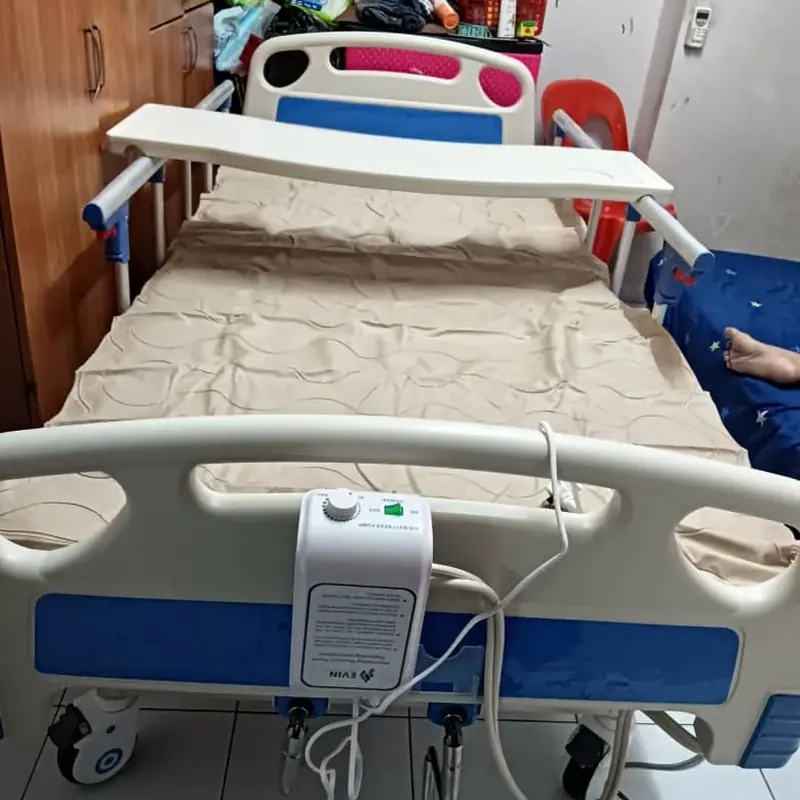
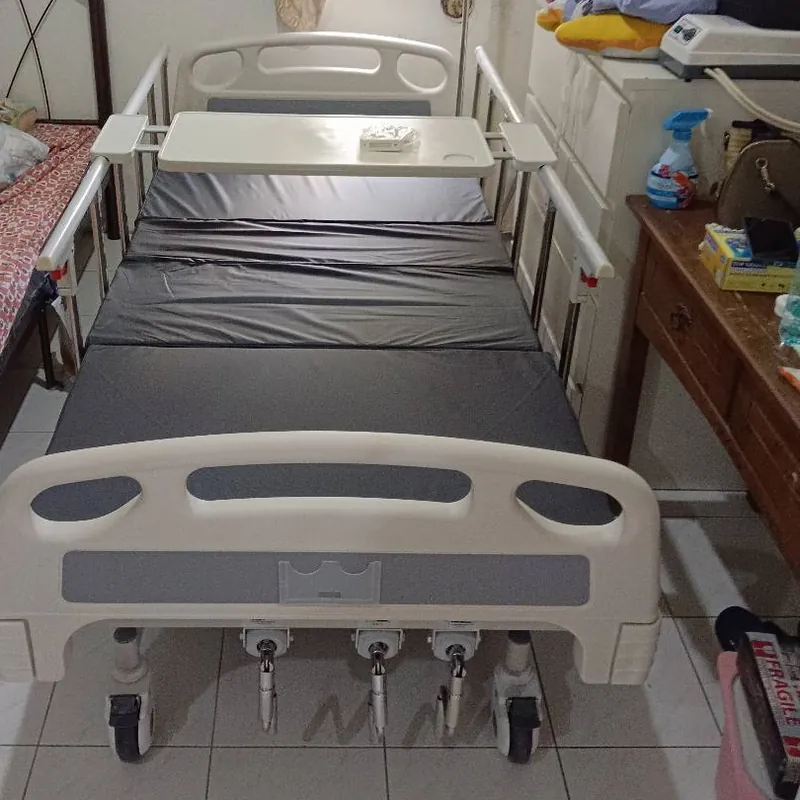
Our hospital beds rent for RM150 a month (Standard 2 Function), RM250 (Flexi 3 Function) or RM450 (3 Function Auto), for the bed only, with an RM0 deposit for every duration, including one month. Payment is collected after the bed has been delivered and installed. One-way delivery within Malaysia costs up to RM280, confirmed for your address, and a mattress is included only if the written quotation lists it. Our ripple mattress is sold for RM199. It is an overlay that sits on top of a base mattress; it does not replace it. See hospital bed rental and ripple mattress.
Caring for a bedbound person at home
The palliative team will give you a plan for your family member. The basics below come from NICE, the NHS, Marie Curie and Hospis Malaysia’s carer’s guide:
- Keep the emergency number. Ask the palliative team at the first visit which number to call out of hours, and when to call 999, and keep it by the bed. Hospis Malaysia, for example, gives registered patients a 24-hour emergency number.
- Change position. NICE CG179 says adults at risk of pressure ulcers should be encouraged to change position frequently and at least every 6 hours, or at least every 4 hours if at high risk, with help if they cannot move themselves. These are minimums, not targets; follow the frequency the care team sets. NICE also advises against offering skin massage or rubbing as a form of pressure-ulcer prevention.
- Check pressure areas. The NHS says pressure ulcers usually form over bony parts such as the heels, elbows, hips and tailbone. Tell the palliative team about discoloured patches that do not change colour when pressed, or skin that feels warm, spongy or hard. Get help the same day if the skin is hot, swollen or red (it can look blue or purple on brown or black skin), pus comes out, the person has a high temperature, or the pain is severe or getting worse.
- Breathlessness. Marie Curie suggests leaning back against a few pillows so the person is sitting upright, or lying on one side with pillows under the head and shoulders, and notes that not every position works for everyone. Hospis Malaysia’s guide suggests loose clothing and more air flow from an open window or a fan. Tell the doctor or nurse if breathlessness is new or getting worse; if it comes on suddenly or is severe, call the hospice’s emergency number.
- Nausea. Hospis Malaysia’s guide suggests small meals through the day and sitting upright, or lying with the head raised, for an hour after eating. Tell the clinical team immediately if there is blood in the vomit, the person cannot keep medicine, food or fluids down, becomes weak, dizzy or confused, has pain with the nausea or vomiting, or has had no bowel movement for more than 3 days.
- Mouth care. Check the mouth every day for redness, swelling, sores, white patches or bleeding and tell the clinical team if you see them; use a soft-bristled or children’s toothbrush and keep the lips moist.
A hospital bed’s backrest can be raised if the care team recommends a sitting position, and a bed with adjustable height makes it easier for a carer to turn the person and change pads or clothes. Bed rails are a decision for the care team. MHRA’s most serious reports involve the head, neck or chest becoming trapped in gaps between the rail, mattress and bed frame, and it reports confused or disoriented people climbing over rails and falling from a greater height. MHRA also notes that a mattress overlay, such as a ripple mattress, raises the person relative to the top of the rail and makes the rail less effective. Ask the care team to reassess the rails whenever you add or change a mattress or overlay. More on choosing a bed is in hospital beds for home use, and on pressure injuries in bedsore care at home.
Support for carers
We did not find a JKM or KKM cash benefit specifically for palliative patients. A caregiver can check JKM’s carer allowance (BPT): RM500 a month, according to MyGOV, for households earning up to RM5,000 a month (Budget 2027 announced RM600, no start date yet). It covers caregivers of bedridden OKU or bedridden chronic patients; JKM also accepts chronic patients who are not bedridden but need continuous treatment for at least 3 months, and pays a bedridden patient who has no carer, or whose carer is not a citizen, in the patient’s own name. KKM’s PPD Paliatif is a home treatment service, not cash aid. Other routes, such as zakat and community equipment loans, are covered in free hospital bed aid (in Malay).
Questions about hospice and palliative care in Malaysia
What is the difference between hospice and palliative care?
Palliative care is an approach that improves the quality of life of patients and families facing a life-threatening illness. In Malaysia, “hospice” usually means a non-profit organisation that provides palliative care at home. MHPCC says the principles of care are the same.
Is hospice care free in Malaysia?
KKM’s National Palliative Care Policy says NGO community palliative care is provided free, and the hospices we checked that publish their charges, including Hospis Malaysia, Hospice Klang and Penang Hospice Society, state that their services are free. Hospis Malaysia says patients may be asked to buy prescribed medication for long-term treatment, and some hospices take a refundable deposit for loaned equipment.
Who can get palliative care in Malaysia?
WHO says palliative care is for patients and families facing a life-threatening illness, not only cancer: it includes heart disease, chronic lung disease, kidney failure, dementia and Parkinson’s disease. Each hospice sets its own conditions and area; Kasih Hospice Foundation, for example, accepts stage 4 cancer and end-stage kidney failure.
How do I get a hospice referral?
Ask the treating doctor for a referral, or ask the hospital or health clinic about KKM’s PPD Paliatif. Some hospices, such as Penang Hospice Society and Hospice Klang, let the family start the referral.
Can I borrow a hospital bed from a hospice?
Often, yes, if the patient is registered with a hospice and lives in its area. Most hospices we checked lend hospital beds and ripple mattresses without charge, subject to stock and each hospice’s conditions (several accept cancer patients only). Some take a refundable deposit, and the family may need to arrange transport.
Does a hospice send a nurse every day?
Not usually. MHPCC says hospice home programmes typically visit every 2 to 4 weeks, and Hospis Malaysia says it does not provide nursing help in the home; its team visits and teaches the carer, so the family still needs to plan daily care.
Is there palliative care at home in Kuala Lumpur?
KKM’s PPD Paliatif is not yet available in Kuala Lumpur, Putrajaya or Labuan, according to MyGOV. In Kuala Lumpur, Hospis Malaysia makes home visits within its coverage area, and Kasih Hospice Foundation’s coverage map includes Kepong, Jinjang and Segambut; ask each whether your address is covered.
Sources
- WHO: Palliative care fact sheet, 5 August 2020.
- KKM: National Palliative Care Policy and Strategic Plan 2019–2030.
- KKM: World Hospice and Palliative Care Day media statement, 11 October 2025; Malay Mail: target of 50 palliative care specialists, 11 October 2025.
- MyGOV: KKM care services for bedridden OKU patients (PPD and PPD Paliatif), updated 13 March 2026.
- MHPCC: Hospice explained; MHPCC member directory.
- Hospis Malaysia, FAQs and Carer’s Guide (English).
- Hospice Klang: loan of medical equipment and referral; Kasih Hospice Foundation: our services; Penang Hospice Society: our services; Perak Palliative Care Society: home care and loan of medical equipment; NCSM Sarawak Branch: get help; Palliative Care Association of Miri: medical equipment loan and loan terms and conditions. All checked 17 October 2026.
- NICE CG179: Pressure ulcers, recommendations 1.1.8–1.1.10; NHS: pressure ulcers; NHS: end of life care; Marie Curie: breathlessness; MHRA / GOV.UK: Bed rails: management and safe use.
- MyGOV: Bantuan Penjagaan OKU Terlantar / Pesakit Kronik Terlantar (BPT), updated 13 March 2026. Our prices and terms: verified fact registry.
This page is general information, not medical advice. Follow the care plan from the patient’s doctor and palliative team. We supply hospital beds; we are not a hospice.